
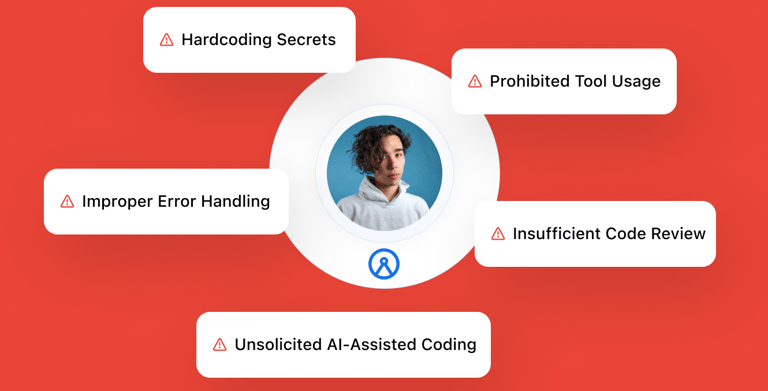
Developer behavior monitoring refers to the collection of activity signals that help explain how developers interact with code, tools, and workflows across the SDLC.
On its own, behavior data has limited value. Its impact comes from how these signals are correlated to risk, attribution, and remediation.
Developer Security Posture Management (DevSPM) translates developer behavior signals into actionable security insights—linking scan results, tool usage, and actions to developer identity across the SDLC.
Capabilities that form the foundation for solving these challenges include:
Developer Profiling and Ranking: Creating detailed developer profiles that capture individual contributions, associated risks, and behavior patterns, offering actionable insights into application security.
Developer Monitoring: Monitoring activities such as code contributions, AI-assisted coding usage, and interactions with unapproved software or shadow IT environments to uncover potential vulnerabilities.
Behavioral Pattern Recognition: Analyzing developer workflows to detect risky behavior trends or early indicators of insider threats, enabling preventive measures.
Dynamic Vulnerability Assessment: Continuously identifying vulnerabilities linked to insecure practices, compromised environments, or poor dependency management to enhance overall security.
These capabilities provide a framework for aligning developer actions with security policies, fostering secure development and compliance across the software lifecycle.
Developer risk often arises when insecure practices go unnoticed—such as unverified dependencies, insecure AI-generated code, or misuse of tools and environments.
Without developer-aware visibility, these behaviors accumulate without clear ownership or accountability.
For instance, insider threats—whether through malicious intent or compromised credentials—can lead to inserted vulnerabilities, stolen proprietary code, or unauthorized data sharing. Here, detecting developer actions plays a critical role in detecting and mitigating such risks effectively.
Shadow IT introduces additional challenges, as unapproved tools and environments bypass security oversight, creating blind spots within the SDLC. Monitoring developer behavior ensures compliance with security posture policies and minimizes these risks.
Risky practices—such as using insecure AI code generators, failing to secure sensitive data, or integrating unvetted dependencies—further exacerbate vulnerabilities. These behaviors can expose secrets like API keys and credentials, resulting in security breaches.
Behavior monitoring tools offer the context needed to identify, triage, and address vulnerabilities linked to specific developer actions. They streamline incident response workflows and ensure alignment with security objectives.
Real-world incidents consistently demonstrate that unmanaged developer actions and limited visibility into developer security posture increase organizational risk—reinforcing the need for developer-aware security:
Insider Threats and Identity Mismanagement, Uber Breach (2022): A hacker exploited compromised developer credentials to access internal systems, exposing sensitive data. This breach highlighted the risks of inadequate behavior oversight in development environments.
AI Code Vulnerabilities, GitHub Copilot Security Flaw (2024): Researchers discovered that insecure code snippets, including those prone to SQL injection and XSS, were occasionally suggested by AI tools if your existing codebase contains security issues, emphasizing the risks of relying on unchecked AI-generated code.
Archipelo integrates into development workflows—via CI/CD, browser, and IDE extensions—to create a historical record of developer actions tied to identity and outcomes across the SDLC. Archipelo complements existing ASPM and CNAPP tools by adding developer-aware visibility, attribution, and accountability.
How Developer Behavior Signals Support DevSPM
Developer Security Posture
Generate posture insights based on security risks introduced by developer actions across teams.Developer Vulnerability Attribution
Trace vulnerabilities and scan results to the developers and AI agents who introduced them.Automated Developer & CI/CD Tool Governance
Identify unapproved tools and environments that expand risk and reduce visibility.AI Code Usage & Risk Monitor
Observe AI-assisted development to ensure secure and responsible software development.
When developer behavior signals are ignored, organizations face:
Vulnerabilities with no clear owner
Shadow IT expanding the attack surface
Repeated insecure practices across teams
Developer Security Posture Management makes developer behavior observable—human and AI—so teams can address root cause, not just patch symptoms.
Archipelo delivers developer-level visibility and actionable insights to help organizations reduce developer risk across the SDLC.
Contact us to learn how Archipelo supports secure development practices while aligning with DevSecOps principles.